Sunday, March 9, 2014

Immune System Quiz

Explain how the immune system achieves all of the following.

  1. Provides an immediate nonspecific immune response
  2. Activates T and B cells in response to an infection
  3. Responds to a later exposure to the same infectious agent
  4. Distinguishes self from nonself
1. Immediate nonspecific immune responses are not geared toward one specific pathogen, but exist to stop pathogens from entering the body in the first place.  There are two different types of nonspecific defense: the first and second lines of defense.  The first line is comprised of mechanical, chemical, and biological barriers.  The mechanical barriers are physical, such as kin and mucous layers.  The mucous membranes line body opening, like the nose and mouth, and organs that have direct connection to the outside of the body, like the GI tract.  These membranes have cilia that sweep pathogens to the outside of the body.  The skin and mucous also create chemical barriers by secreting proteins.  One important chemical barrier is the lysozymes, an enzyme that destroys pathogens by opening their cell walls.  These chemical barriers can be found in body secretions, which are often acidic, and help defend against pathogens.  The biological barriers are living organisms, like bacteria that live on the skin and prevent harmful bacteria from taking root outside or inside the body by competing with them for nutrients.  The second line of defense is for when a pathogen actually enters the body.  Inflammatory responses, like when cuts swell, are reactions to tissue damage.  This damage releases cytokines and histamines, which communicate between cells and cause inflammation, respectively.  The swelling increases blood flow to the area in order to remove pathogens and start healing.  Cytokines also bring white blood cells to the wound.  White blood cells, or leukocytes, exist to find and destroy foreign objects in the body.  There are both specific, and nonspecific leukocytes.  The nonspecific leukocytes, monocytes, macrophages, and neutrophils by enveloping pathogens and digesting them, a process called phagocytosis. 
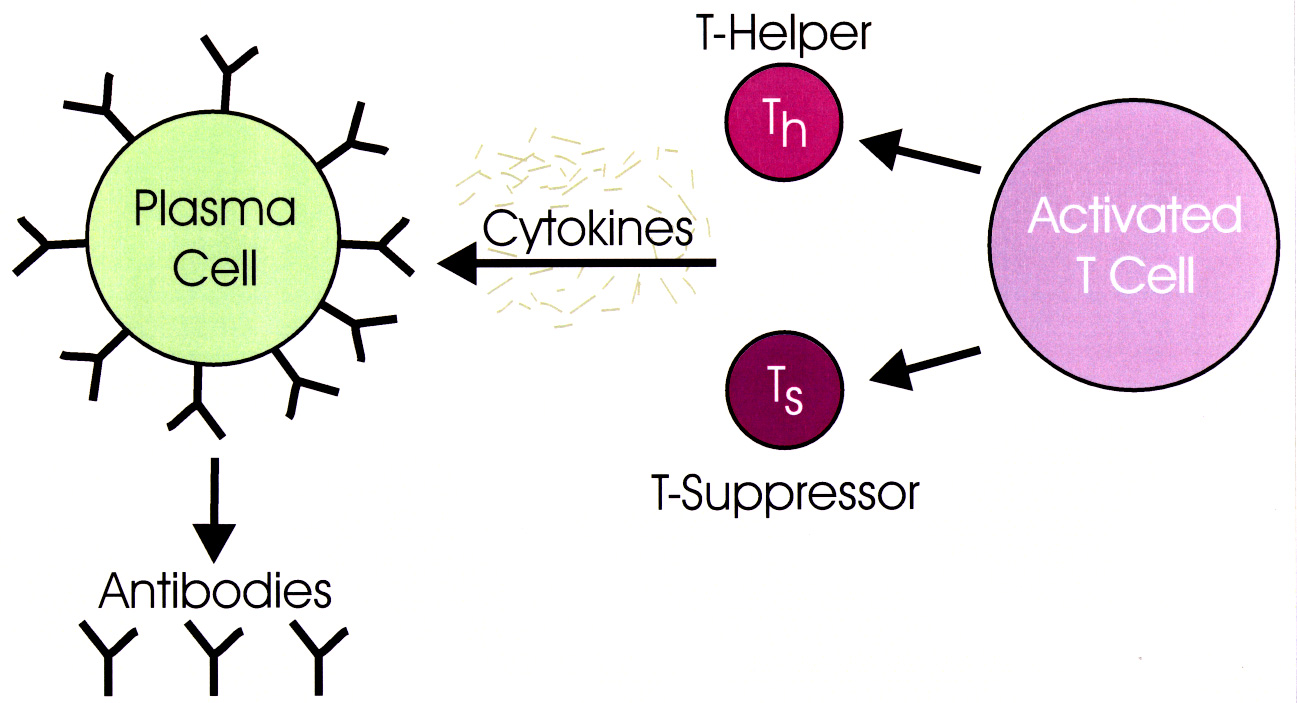
2. T and B cells are lymphocytes, meaning that they are tailored to certain pathogens.  However, it isn’t the pathogens they react to, but rather the antigens, or molecules, of the pathogens.  Their receptors recognize specific antigens and bind to them, but these lymphocytes can only recognize one antigen each.  Before they find their specific pathogen, these cells are considered naïve.  B cells are responsible for the humoral immune response, which means they are responsible for producing antibodies.  When naïve B cells first encounter an antigen, they engulf it, digest it, and display fragments of it on their surfaces.  T cells then bind to the B cells in order to release cytokines, which then help the B cells retain memory of the antigen as a plasma cell or memory cell.  Next, these plasma cells create antibodies that react to the same antigen that the B cell initially engulfed.  Whereas plasma cells are only temporary, plasma cells can last a lifetime and initiate an immediate immune response to the antigen that created them.  T cells are activated in generally the same way.  Helper T cells, on the other hand, do not actually destroy pathogens.  Instead they create chemical signals in order to help activate T cells and help them to activate B cells.  When the pathogen is cleared from the body, these helper T cells either die or become memory cells.  Cytotoxic T cells destroy all damaged cells, whether they be cancerous or infected by a virus.  These cells quickly reproduce in order to create a swarm that can combat against their specific antigen.  When the pathogen has been removed (these T cells are kamikazes, dying when they destroy their pathogens), the T cells die off or become memory cells.  Regulatory T cells mandate the entire process.
3. After T and B cells have been activated to a pathogen, their body becomes immune to it, either actively or passively.  Active immunity is when the memory cells are left behind for a specific pathogen, so the pathogen has a harder time re-infecting the body.  Immunization can also lead to active immunity by exposing the body to a dead or weakened form of the pathogen so the body can recognize it without ever getting sick.  Passive immunity is when the body receives antibodies, as opposed to creating them, for a certain pathogen.  This only lasts as long as the antibodies are alive in body fluids.
4. T cells and B cells are programmed to respond to certain antigens.  Since body, or “self” cells do not have molecules that read as foreign, the immune system does not have a problem.  When “non-self” pathogens enter the body, these cells recognize their foreign antigens and react to them as a threat.  Sometimes, T and B cells react to non-harmful foreign substances, called allergens, and create an allergic response to them.  In rarer cases, the immune system mistakes “self” for “non-self,” and begins to attack the body, in what is called an auto-immune disease.           

References:

Quick, Kevin, Holly Kiamanesh, Rosie Montague, Jean Brainard, Barbara Akre, and Douglas Wilkin. The Webb Schools Biology Textbook. N.p.: CK-12, Flexbook, 2012. Print.

Thursday, February 27, 2014

De Rerum Virute

So I'm on Unbounded and we've been talking about this poet, Robinson Jeffers. I was reading this poem, and I totally felt like it needs to be on this blog. This is part 2 of "De Rerum Virute." I thought this was a pretty cool and artsy take on evolution, and I'm digging it.

That’s what it’s like: for the egg too has a mind, 
Doing what our able chemists will never do, 
Building the body of a hatchling, choosing among the proteins: 
These for the young wing-muscles, these for the great 
Crystalline eyes, these for the flighty nerves and brain: 
Choosing and forming: a limited but superhuman intelligence, 
Prophetic of the future and aware of the past: 
The hawk’s egg will make a hawk, and the serpent’s 
A gliding serpent: but each with a little difference 
From its ancestors—and slowly, if it works, the race 
Forms a new race: that also is a part of the plan 
Within the egg. I believe the first living cell 
Had echoes of the future in it, and felt 
Direction and the great animals, the deep green forest 
And whale’s-track sea; I believe this globed earth 
Not all by chance and fortune brings forth her broods, 
But feels and chooses. And the Galaxy, the firewheel 
On which we are pinned, the whirlwind of stars in which our sun is one dust-grain, one electron, this giant atom of the universe 
Is not blind force, but fulfils its life and intends its courses. “All things are full of God. 
Winter and summer, day and night, war and peace are God.” 

Monday, February 24, 2014

Epinephrine

https://drive.google.com/file/d/0B-CMOaD3WtX5aWpLZHg0Qzh0TE0/edit?usp=sharing
(If you don't want to download the podcast, simply add the app "Music Player for Google Drive" to your Google Docs and then you can open the audio in the app)
Transcript
            Did you know that adrenaline has another name, and that it’s actually used more often?  This hormone currently goes by the name epinephrine, and it has a key function in our bodies.  Have you ever heard of fight or flight, the impulse to either run or stand your ground in a dangerous circumstance?  How about a person lifting a car off of their child in a life or death situation?  Well these responses are caused by epinephrine, which is released when the brain experiences stress.  When it is released into the blood stream, it can raise your heart rate, strength, blood pressure, and metabolism to make you a more highly functioning human being.   However, its effects are only temporary so epinephrine can’t make us all Superman.
             Epinephrine is produced in the medulla, or core, of the adrenal gland, which sits on top of the kidneys.  When you feel stressed, angry, or afraid, your brain releases a signal through the sympathetic nervous system to the adrenal gland, which begins to produce epinephrine.  Since this process begins with a response in the hypothalamus that triggers another response in the adrenal gland to produce the hormone, it is a neuroendocrine pathway. 
When epinephrine is released, it binds to the outside of cells, called adrenergic receptors, on their membranes.  There are two types of adrenergic receptors, alpha and beta, that have different responses when the epinephrine binds to their membranes.  This bond makes the receptor change its shape to become active.  From this point on, the epinephrine functions through a series of G proteins that produce GDP.  The proteins activate an enzyme that converts mass amounts of ATP into signaling molecules.  After a certain amount of time, the receptors become inactive, but the chemical reaction continues, eventually removing phosphate groups from glucose molecules.  Without the phosphates, glucose can directly pass into blood cells, creating the fight or flight response.     
Epinephrine has two types of feedback loop: the adrenaline-cardiovascular feedback loop and a short-term stress response.  The adrenaline-cardiovascular feedback loop is dependent on your heart rate.  When your heart rate is too slow you produce epinephrine to make it faster, but if it is too fast epinephrine production stops.  The short-term response is caused by either perceived or threatening stress.  With perceived stress, or the stress caused by your job or homework, the epinephrine is underused and can be harmful.  With threatening stress, or that car speeding toward you, your body releases epinephrine in order for you to have the best chance of staying alive.  In all situations, your hypothalamus sends signals through your spinal cord telling your adrenal glands that you need the epinephrine to survive.  This entire system is a negative feedback loop, as the production of epinephrine does not provide for more of the hormone to be made, but new studies are showing that extreme circumstances can make its production into a positive feedback loop.
The last, but not least, important fact about epinephrine is that it is hydrophilic, allowing it to diffuse through blood plasma and dissolve in water.  This is evidenced by its bonds with the cell membrane, as opposed to the nucleus of cells, since the membrane is made of some fats.  Water-soluble hormones are made of amino acids, the building blocks of proteins.
While all these scientific facts about epinephrine make it sound strange, everyone has heard of an epi pen.  When someone with an allergy goes into anaphylactic shock, epinephrine is used to get their heart going and change their blood flow so that swelling will decrease.  Epinephrine is a large part of modern medicine and culture, with phrases like “adrenaline junkie” used commonly today.  This hormone is one of the most well known and important in our bodies, even if we only know it by a different name.      
References
"Signal Transduction Pathway." Whfreeman.com. W H Freeman Publishers, n.d. Web.
Cashin-Garbutt, April. "What Is Epinephrine (Adrenaline)?" News-medical.net. News Medical, n.d. Web. 
"Epinephrine Molecule." Worldofmolecules.com. World of Molecules, n.d. Web.
"Epinephrine." Udel.edu. University of Delaware, n.d. Web.


Tuesday, February 18, 2014

FOR STANDARDS: The Functionality of Bromelain in Different pHs: Jell-O Lab Report

ABSTRACT
            To examine the effect of pH on the function of bromelain, an enzyme found in pineapple, we prepared 4 samples of lime Jell-O with fresh pineapple juice and different amounts of strong acids and bases.  Our control sample was Jell-O with 1 mL pineapple juice and a pH of 4.  Our other samples all had 1 mL of pineapple juice as well, but NaOH and HCl were added to the samples in order to obtain pHs of 1, 8, and 12.  They were left to freeze and after two days only one dish of Jell-O had set, the one with a pH of 12.  This means that the conditions were basic enough to denature the bromelain enzymes from the pineapple juice, and inhibit them from breaking down the gelatin, which helps the Jell-O solidify.  The other plates were still liquid, meaning the conditions were favorable for the enzymes, although the acid in the pH 1 dish should have denatured the enzymes as well.
INTRODUCTION
            Since different enzymes can thrive in different pH levels, the four samples of Jell-O with pineapple juice were prepared to find the optimum pH for bromelain.  Bromelain is an enzyme found in pineapples that breaks down proteins, like the ones found in gelatin.  Gelatin is made from the collagen from ground up animal parts, and pineapples have enzymes to break down collagen because animals are able to digest their seeds.  In order to create a next generation, the seeds ideally should exit the animal’s digestive system undisturbed.  By breaking down this collagen, the seeds can inhibit the digestion that would occur in the small intestine by disturbing the epithelium, which is made of collagen (Gregerson 2003).
For some enzymes, conditions that are too acidic or basic can denaturize them and inhibit their function, while others thrive in these extreme environments.  The primary function of enzymes is to catalyze reactions between substrates, or molecules.  This means it lowers the activation energy of the reaction, or in other words allows the molecules to combine or separate more efficiently than they would on their own.  However, certain external conditions, such as pH or temperature, can stop an enzyme from performing its action.  These factors alter the shape of the active site, the place where the substrates are received, so the enzyme can no longer accept molecules and catalyze their reactions.  This process is called denaturing, and it is permanent.  In this lab, the denaturing effects of pH specifically were examined, in normal, acidic, basic, and close to neutral conditions.
HYPOTHESIS
If the pH is 1 and very acidic, the enzymes will be denatured and the Jell-O will set.
If the pH is 4 like it normally is, the enzymes will function normally and the Jell-O will not set.
If the pH is 8 and close to neutral, the enzymes will function normally and the Jell-O will not set.
If the pH is 12 and very basic, the enzymes will be denatured and the Jell-O will set.
MATERIALS
4 petri dishes
1 beaker
6.67 grams of lime Jell-O mix
39 mL of boiling water
39 mL of cold water    
Stirring rod
Litmus paper
50 mL NaOH (only use what is needed to reach target pHs)
50 mL HCl (only use what is needed to reach target pHs)
4 mL fresh pineapple juice
3 pipets
Freezer
PROCEDURE
1. Pour Jell-O mix into beaker and add 39 mL of boiling water.  Stir until the powder is dissolved.
2. Add 39 mL of cold water.
3. Separate the mix into four equal parts, and then pour into four petri dishes.
4. Take the pH of one dish.  Add 1 mL of fresh pineapple juice.
5. Add HCl to the second dish.  Add in 1 mL increments and take the pH until it reaches a pH of 1.
6. Add NaOH to the third dish.  Add in .5 or 1 mL increments and take the pH until it reaches a pH of 7, or 8 if you overshoot.
7. Add NaOH to the fourth dish.  Add in 1 mL increments and take the pH until it reaches a pH of 12
8. Add 1 mL of pineapple juice to the final 3 petri dishes.
9. Label the petri dishes and place them in a freezer.
10. Check the dishes after anywhere from a couple hours to a few days later.  Observe which are still liquid and which have set.
RESULTS

pH 1
pH 4
pH 8
pH 12
Did it set?
No
No
No
Yes
 In the sample with pH 1, the Jell-O was liquid, meaning that the bromelain was able to maintain its shape and function in the very acidic solution.  However, the enzymes should not have been able to function in a solution of such low pH, meaning that the pH reading may have been wrong.
In the sample with pH 4, the Jell-O was liquid, so the bromelain was able to maintain its shape and function in the regular pH of Jell-O.
In the sample with pH 8, the Jell-O was liquid, indicating that neutral or slightly basic solutions do not inhibit bromelain’s function.
In the sample with pH 12, the Jell-O set, which indicates that the conditions were too basic and denatured the bromelain, inhibiting it from digesting the collagen in the Jell-O.
CONCLUSION
            With the exception of the dish of pH 1, our hypotheses matched our results.  Our control, the unaltered pH 4 plate, did not set as expected, indicating that the bromelain functions in slightly acidic solutions.  Our pH 8 plate showed the enzyme can also work in slightly basic solutions, but our pH 12 plate confirmed that very basic solutions denature the enzyme.  The anomaly was the pH 1 plate, which in theory should have set as well because the solution was incredibly acidic and able to denature the bromelain, but for some reason the enzymes still functioned properly.  This might be due to an incorrect pH reading, since we did not always properly mix our solutions before testing their pH.  If the pH was taken in a more acidic part of the solution, the reading would be lower than it would be for the overall solution, and the pH would not affect the enzymes.  Another mistake we made was probably with one of our two constants, which were the amount of Jell-O and pineapple juice in the petri dishes.  Since we just added one pipet squirt of pineapple juice to each dish, the exact amount probably varied from dish to dish, and there could have been more in the pH 1 dish, and with the improper mixing maybe some of it was not denatured.  If the amount of pineapple juice was not a true constant, another constant was the amount of time the Jell-O was left in the freezer.  While we definitely made one error in this experiment with the pH 1 plate, the rest of our results confirm what we know about enzymes and our hypotheses, and show that bromelain works best in solutions with pHs closer to neutral.
CITATION
Gregersen, Hans. Biomechanics of the Gastrointestinal Tract: New Perspectives in Motility Research and Diagnostics. London: Springer, 2003. Print.