Thursday, April 17, 2014

Arctic Tundra Biome

http://www.telegraph.co.uk/earth/earthpicturegalleries/8283268/Pole-to-pole-Daniel-J-Cox-photographs-Arctic-polar-bears-and-penguins-in-Antarctica.html

The summer before 5th grade I took a trip to Alaska, and finally it has paid off! For my biome, I am doing the arctic tundra, so I'll present you with some pretty dull facts paired with some pretty interesting life experiences (you won't wanna miss this!). Life comments will be in purple, factoids will be in boring old white.
http://www.marietta.edu/~biol/biomes/tundra.htm


Abiotic Features
Soil type/minerals: The soil is lacking in nutrients, which barely matters since hardly anything can grow in the tundra anyway.  Under the soil is a layer of permafrost, or a layer of ground that is permanently frozen, all year long.  Since this layer is close to the top of the soil, there isn’t much room for plants to take root.
Water: There is little to no precipitation in the tundra, so it’s almost like a desert.  Only about 6-10 inches of rain fall in the tundra every year.  This precipitation can create small ponds, similar to the ones created when the weather gets warmer and the frost on the ground melts.
http://climhy.lternet.edu/documents/climdes/arc/arcclim.htm

Air: The elevation of arctic tundra ranges from 300-10,000 meters, so the air pressure varies depending on location, but is generally on the higher end of the spectrum (low elevation means high pressure).  Since the tundra is basically a desert, it is not very humid, with usually 5-10% humidity.
Temperature: During the winter, the average temperature is about -30° Celsius, with the lowest temperatures reaching -78°.  During the summer, the average temperature is between 3° and 12° Celsius. 
So like, the tundra is cold right? We knew that, but we figured since it was summer we'd be okay. Yeah no. My dad loved the cold (about 50-60° F), but it was definitely not what I expected out of my summer. Us Californians are not adapted to that weather, and I was never as painfully aware of that as I was that week. (The cute husky picture may be a little unrelated, but I think it properly expresses the coldness, see his little sweater?!)
http://peanutpumpkinpie.blogspot.com/2013/01/peanut-economics-exploring-arctic.html
Sunlight: During the short summer, the sun is up almost 24 hours a day, giving the tundra the name “land of the midnight sun.”  However, during the winter the sun only rises for several (if that) hours a day, so it is almost always dark.
Prior to this trip, I was rarely up until even 11 PM. I maintain this is what made me a night owl, because it was literally only dark for like two hours a night, so I could NEVER sleep. Not that I really minded, since it was pretty interesting to see the "night" life.
Shelter: There is not much shelter for animals, since the ground is relatively flat.  There are some caves, but more animals use snow caves for shelter during hibernation.
http://ed101.bu.edu/StudentDoc/Archives/ED101fa09/doamaral/Land.html

Biotic Components
Producers: There are only 1700 species of plants in the arctic tundra, ranging from flowering plants to shrubs.  The growing season is only about 90 days long, so these plants do not have much time to take root.  Some examples of tundra plants are: arctic willows, bearberries, arctic poppies, and cotton grass.  Like bearberries and pasque flowers, some arctic plants are covered with fine, silky hairs.  These hairs provide the leaves and stems with insulation from the cold, which allows them to grow and continue photosynthesis despite the freezing temperatures.
Apparently there is an equivalent of poison ivy in Alaska. I was not aware of that. You can assume what happened. The arctic flowers are really surprisingly pretty though, and the Native Americans had so many uses for them!
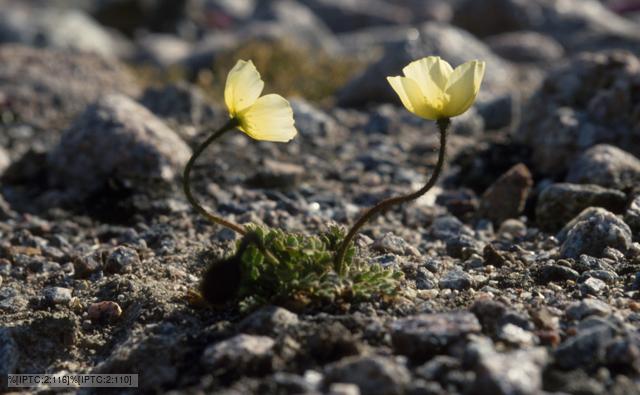
http://www.bbc.co.uk/nature/life/Papaver_radicatum

Consumers: There is not much biodiversity in the tundra, and many animals are migratory and only reside there for the warmer parts of the year, such as birds and caribou because of the relative lack of predators.  Some tundra animals are: polar bears, arctic foxes, snowy owls, and arctic hares.  Of course, these animals need some defense against the cold, so they have evolved short ears to reduce heat loss, thick coats, and many hibernate during the coldest winter months in order to conserve energy.
Bears! We saw bears! And birds of prey. And musk oxen, which smell...not as pleasant as you would expect them too. Also everything has this white fur that looks super soft and really pet-able...Look at this arctic fox! If that's not the cutest thing ever, you're wrong.
http://www.zoo.org/view.image?Id=469

Decomposers: The decomposers in the arctic work very slowly, because the cold slows down their metabolism.  In the summer, mushrooms can grow, but for the rest of the year decomposition is almost at a halt, so bodies of dead animals can still be around years after their death.  Some decomposers are arctic moss, mushrooms, and bacteria.  Microorganisms like bacteria have genes that allow them to survive in cold environments and can die in warmer environments.  These genes have properties similar to antifreeze to give them the best capacity to survive, and their genes have been useful in created human vaccines.
Yeah, that medication could have been useful. My dad got pneumonia (it started as a sinus infection, you know the curse: can't go on vacation without getting sick!).
Food Web
http://hwood6.wix.com/arctictundrabiome?_escaped_fragment_=arctic-tundra-food-web

Symbiotic Relationships
The most common symbiotic relationship in the arctic is lichen, a combination of a fungus and algae.  The algae provide sugars to the fungus, and the fungus protects the algae so it can survive.
http://www.aitc.sk.ca/saskschools/arctic/Aplants3.html


Human Influence:
One very obvious risk to the arctic tundra is global warming, a problem created by modern society.  Because the rising temperatures have caused ice flows to melt, animals like polar bears often find themselves displaced.
Another problem created by modern society is a growing need for oil, much of which happens to be found in the arctic.  Drilling for oil not only disrupts the environment, but leaves potential for pollution and takes homes away from animals.

So, to plan my next trip to the arctic tundra, I guess I should reference this map!
http://www.marietta.edu/~biol/biomes/tundra.htm
Thanks for going on this trip with me! Hope you have more biology-themed adventures of your own!
Sources/Sites to check out!

Want to help protect the arctic tundra?

Want to look at pictures of arctic animals just 'cuz? (I know I do)

Friday, April 11, 2014

Pill Bugs’ Response to Moisture, Scent, and pH (FOR STANDARDS)

Abstract
            To determine which environments pill bugs prefer, we performed up two different experiments to test conditions like moisture, scent, and pH.  We set up these experiments in behavior chambers by laying filter paper on the bottom, and then adding water, vinegar, and HCl.  We then added ten pill bugs to the chamber and recorded how many were on either side after every thirty seconds, spending seven minutes on each of our three trials.  Our first trial, with a dry and wet side, indicated that pill bugs prefer dry conditions.  The next trial, with a water side and a vinegar side, revealed that pill bugs prefer unscented environments.  Our last trial, with a water side and an HCl side, indicated that pill bugs prefer neutral conditions to acidic conditions.
Introduction
            The dictionary defines behavior as “observable activity in a human or animal.”  Basically, animal behavior is everything an animal does, from eating to mating, and the mechanics behind these actions. The science of animal behavior is called ethology, and it has several parts to it, all starting with proximate and ultimate questions.  Proximate questions have to do with the how of a behavior and the mechanics behind it, while ultimate questions are about the why of a behavior and what it accomplishes.  An example of an ultimate question is “Why does a bird sing?” or “Does birdsong help birds mate?”  An example of a proximate question is, “What makes a bird know when to sing?” or “Is birdsong a fixed action pattern?”  Fixed action patterns are behaviors that are ingrained in animals and happen in response to a stimulus.  Animals have never been taught how to do these actions but rather know how to do them instinctively.  An example is bird-mating dance, like when a male bird sees a lady bird he wants to woo.  The stimulus, her presence, causes the male to begin a dance like motion that must be carried to completion.  Not all animal behaviors are unlearned however, and imprinting is a big part of animal development.  Imprinting is a period of swift learning in a young animal’s life in which it very quickly attaches itself to a parent and begins borrowing characteristics from it.  Young geese can imprint on humans or other animals, recognizing them as a mother and following them around unceasingly.  A proximate cause might be that they are genetically compelled to find a mother figure, and an ultimate cause could be that by finding a mother figure, they are more likely to survive.  The tendency for geese to follow around their mother figure could be described as taxis, or intentional movement.  Taxis is direct movement in response to a stimulus.  Kinesis is much less specific, and animals simply move around randomly until they find suitable conditions.  This pill bug lab is an example of kinesis, as the pill bugs meandered slowly until they found their preferred environment, where they stopped moving.  Stimuli are not only important in movement, they are also important in other physical responses, as seen with classical conditioning.  Classical conditioning is best known in Pavlov’s dogs.  He took a neutral stimulus, a bell ringing, and an unconditioned stimulus, food, and made an association between them in the dogs’ minds.  When the two stimuli became connected, whenever the dogs heard a bell ring, they would begin to salivate like they would if they saw food.  Operant conditioning, on the other hand, is more about voluntary actions and incentive.  By making an animal associate an action with a reward, like giving a dog a treat every time he responds to a command, the dog associates completing the command with something good, and will voluntarily complete the action.  So, classical conditioning is more about involuntary responses, while operant conditioning makes animals voluntarily act.    
Hypothesis
Part 1:
If pill bugs are given a choice between wet and dry environments, then they will move toward the wet one because they normally live in moist conditions.
Part 2:
If pill bugs are given a choice between environments with and without a strong smell, then they will move to the scentless one because it is closer to the conditions they normally live in.
If pill bugs are given a choice between neutral and acidic environments, then they will move toward the neutral one because it more closely resembles their natural habitats.
Materials
Part 1:
-10 pill bugs
-2 plastic behavior chambers
-2 pieces of filter paper
-soft brushes
-pipet full of water
-timer
Part 2:
-10 pill bugs
-2 plastic behavior chambers
-2 pieces of filter paper
-soft brushes
-3 pipets
-pH strips
-water
-HCl
-vinegar
-timer
Procedure
Part 1:
First, place the pill bugs in a behavior chamber, and observe them for a few minutes.  Set up the other chamber by placing filter paper on the bottom of each side and dampening one side with water.  Use the brushes to carefully move the pill bugs into the prepared chamber and place them in the center.  Record how many pill bugs are in each chamber, start a timer, and cover them with the other chamber, so it can be dark like the pill bugs prefer.  Every thirty seconds, uncover the chamber and record how many pill bugs are on each side.  Keep observing them for 7 minutes and then graph the results.
Part 2:
Set up the behavior chamber by placing filter paper on the bottom of each side and dampening one with water.  Take the pH of a sample of vinegar and then dampen the other side of the chamber with it.  Use the brushes to place the pill bugs in the center of the chamber and record how many are on each side.  Cover them with the other chamber and start the timer.  Uncover them every thirty seconds and record how many are on each side.  Observe them for 7 minutes and graph the results.  Set up another chamber by placing filter paper on the bottom of each side and dampening one with water.  Make an HCl solution by diluting the acid with water until it has the same pH as the vinegar, and then dampen the other side of the chamber with it.  Place the pill bugs in the center of the chamber, record how many are on each side, then repeat the observation process for 7 minutes.   Graph the results.
Results
Part 1:
The majority of pill bugs were always in the dry chamber, and most bugs did not move at all.  This indicates that the pill bugs prefer dry environments as opposed to wet ones.
Time (min)
Wet
Dry
0
2
8
0.5
2
8
1
2
8
1.5
3
7
2
3
7
2.5
3
7
3
3
7
3.5
3
7
4
3
7
4.5
3
7
5
2
8
5.5
2
8
6
2
8
6.7
2
8
7
2
8


Part 2:
The majority of pill bugs were always in the chamber with neutral pH, and again most bugs did not move at all.  The experiment with the vinegar indicates the pill bugs prefer environments with no scent as opposed to ones with strong smells, and that they might have a preference for neutral environments, which was confirmed by the experiment with HCl.
Time (min)
Water
Vinegar
0
4
6
0.5
6
4
1
9
1
1.5
9
1
2
9
1
2.5
9
1
3
9
1
3.5
9
1
4
9
1
4.5
9
1
5
9
1
5.5
9
1
6
9
1
6.7
9
1
7
9
1


Time (min)
Water
HCl
0
10
0
0.5
8
2
1
8
2
1.5
8
2
2
8
2
2.5
8
2
3
10
0
3.5
10
0
4
10
0
4.5
10
0
5
10
0
5.5
10
0
6
10
0
6.7
10
0
7
10
0

Conclusion
            Our results indicate that pill bugs prefer dry, scentless and neutral conditions.  While our hypotheses for part 2 were confirmed, our hypothesis for part 1 was proven wrong, much to our surprise.  We assumed that because pill bugs normally live in wet habitats that they prefer wet conditions to dry ones, but that was not the case.  Our control chamber, the dry one, seemed like a more favorable environment in part 1, but in part 2 our constant, the water chamber, seemed to be more appropriate for the pill bugs, who were another variable we held constant.  The chambers with the extreme versions of the independent variables (pH and scent), containing HCl and vinegar, were not popular among the pill bugs, leading them to choose the wet chamber.  This dependent variable (number of pill bugs in each chamber) stayed relatively constant throughout the experiment, but that may have been our fault.  We placed some of the filter paper wrong, and a few bugs got stuck underneath it, so they were unable to move.  Some bugs we placed on their backs, so by the time they got oriented our experiment was almost over.  Overall, our results make sense, even though part 1 was a little surprising for us.  We managed to put our knowledge of animal behavior to the test and design a working experiment to answer our questions about pH and pill bugs, so this experiment was an overall success.
Questions
Part 1:
1. What conclusions do you draw from your data? Explain physiological reasons for the behavior observed in this activity.
According to our data, pill bugs prefer dry environments, although their gills would indicate that they like wet environments.  This may be an adaptation to California’s dry climate.
2. How do isopods locate appropriate environments?
They have eyes and sensitive antennae, which allow them to sense the brightness, moisture, and other characteristics of their surroundings.
3. If you suddenly turn a rock over and found isopods under it, what would you expect them to be doing? If you watch the isopods for a few minutes, how would you expect to see their behavior change?
When our isopods made it to their ideal environment, they would stop moving, so I would expect to see the isopods doing nothing.  After leaving them exposed to the sun and heat for a few minutes, they would probably start moving around and looking for a more favorable environment.
4. Is the isopod’s response to moisture best classified as kinesis or taxis? Explain your response.
Their response was kinesis, since they moved randomly around until they found the environment they preferred, and then stopped moving.   They did not directly go to the dry chamber, but instead meandered around, slowing down when they reached the ideal conditions.
5. Identify the control(s), independent variable, and dependent variable in this experiment and explain why you have identified the factor you chose as each.
The control was the dry chamber, because we did nothing to alter it.
The independent variable was the moisture in each chamber, which was damp in one and dry in the other.
The dependent variable was the number of pill bugs in each chamber after every thirty seconds, because this number was affected by the conditions set by our independent variables.
Citations
Cherry, Kendra. "Classical vs Operant Conditioning." About.com Psychology. About.com, n.d. Web.
Meyer, John R. "Elements of Behavior." Elements of Behavior. NC State University, 2006. Web.